




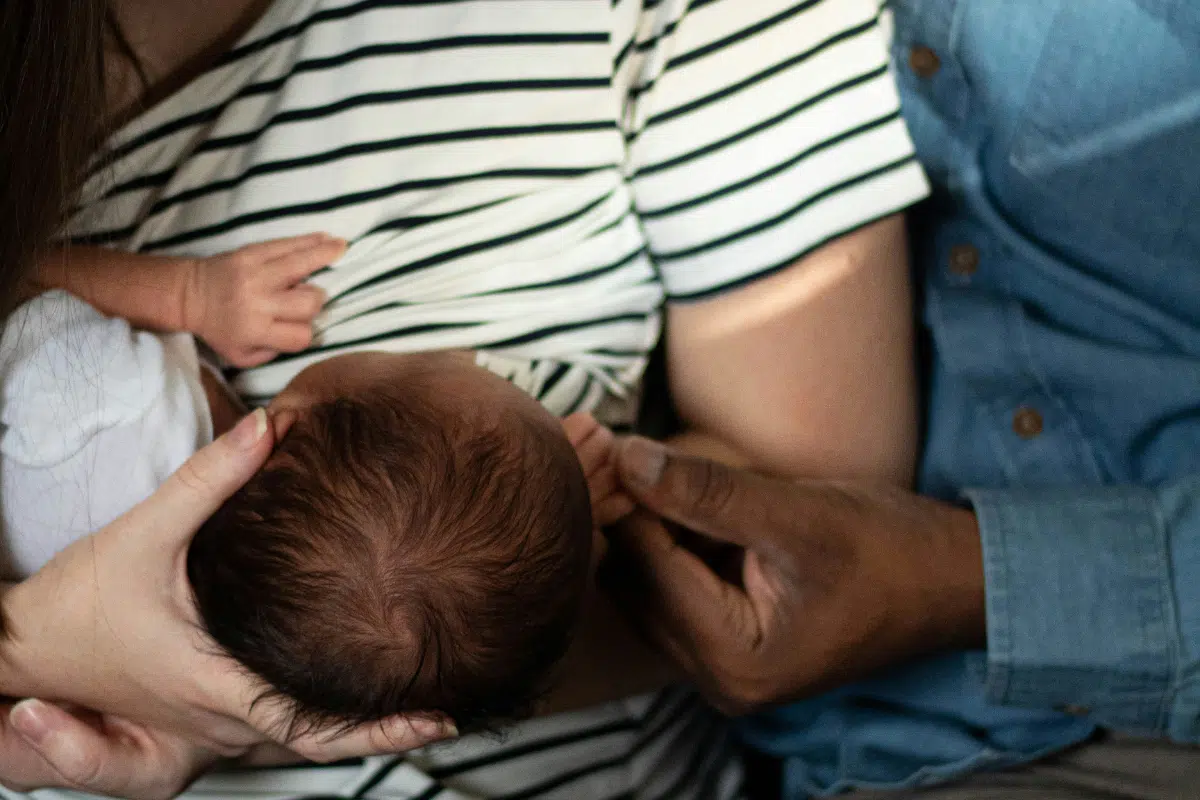

Around two-thirds of couples experience a dip in relationship satisfaction in the first three years after having a baby. This isn’t a sign that something is wrong with your relationship. In fact, it’s one of the most common – and least openly talked about – experiences of early parenthood.
It’s 9pm. The baby is finally asleep. You’re both on the couch in the kind of silence that used to feel comfortable but now feels heavy. One of you wants to reach out. The other wants to be left alone. The tension fills the air, yet neither of you says anything.
If this scene feels familiar, you’re in good company. Research consistently shows that the transition to parenthood is one of the most significant stressors a relationship will face. Conflict increases and your leisure time together disappears. The deep conversations and spontaneous connection that once held you together gets replaced by task coordination: nappies, feeds, who’s doing the night shift. For many couples, this is the first time they’ve felt genuinely lonely inside their relationship.
And yet, most of us walk into parenthood having prepared for the baby with the nursery, the classes and the gear, but with almost no preparation for what’s about to happen to us as a couple.
Why does everything feel so different?
When we’re exhausted and overwhelmed, we reach for our partner differently. One person might try harder to connect; wanting to talk, wanting closeness, wanting reassurance that the relationship is still there underneath the changes. The other might pull away, needing space, needing quiet, needing to not be needed by ‘one more person’.
Neither response is wrong. Both are attempts to manage the same thing: the anxiety that comes with feeling disconnected. The partner who pursues is regulating their distress by seeking proximity, perhaps thinking “if I can get close to you, I’ll feel safe again”. The partner who withdraws is regulating their overwhelm by creating distance, and their internal voice might sound like, “if I can get some space, I can calm down enough to come back”. These two common strategies can become a dance that feels impossible to understand. Each seems to confirm the other’s worst fear: I don’t matter to you anymore.
When couples can see this pattern for what it is – two people in the same storm, reaching for safety in different directions – something shifts. From this view, it’s possible to stop being opponents and start being allies who simply have different nervous systems.
Being ‘touched out’ is a nervous system signal, not a rejection
This is one of the most misunderstood experiences in early parenthood, and one of the most important for partners to understand. Being ‘touched out’ isn’t just a preference or a mood. It’s a nervous system-level response to sustained sensory load. When you’ve spent the day with a baby on your body; being fed from, clung to, climbed on, your autonomic nervous system has been running in high gear for hours. The sympathetic nervous system, responsible for vigilance and responding to demands, has been activated all day. By evening, the body’s capacity for more physical input is genuinely depleted.
It’s not that you don’t love your partner. It’s that your nervous system might be saying: “I have nothing left to give through my skin right now”. When partners understand this as a physiological reality rather than a personal rejection, it can make space for more understanding. It can move the conversation from ‘why don’t you want me?’ to ‘what does your body need right now?’ And that question, asked with genuine care, can itself be a form of intimacy.
Your nervous system after a baby – why desire changes
One of the most helpful ways to understand what happens to sexual desire after a baby is through the concept of ‘accelerators’ and ‘brakes’. Sex educator Emily Nagoski, drawing on the dual control model developed at the Kinsey Institute, describes desire as a system with two parts. The accelerator responds to everything your brain codes as sexually relevant; closeness, feeling attractive, safety, playfulness, touch. The brake responds to everything your brain registers as a potential threat; stress, exhaustion, unresolved conflict, a mental to-do list that never ends, a body that feels unfamiliar.
Here’s the key insight for new parents: postpartum life is almost all brakes and almost no accelerators. The sleep deprivation, the worry, the relentless demands on your body and attention – every one of these is pressing the internal brake. It’s not that desire has disappeared, but rather the conditions for desire have changed dramatically, and most couples haven’t been given the language to understand why.
It also helps to understand that desire itself comes in different styles.
- Spontaneous desire: the kind that seems to appear out of nowhere, is more commonly associated with testosterone-dominant desire cycles and is often (though not exclusively) experienced by men.
- Responsive desire: where interest in sex emerges in response to something already happening, like being touched, feeling emotionally close, or being in the right context, is more commonly linked to oestrogen-mediated pathways and is experienced by a significant number of women.
Neither style is better and both are ‘normal’, as are many variations in between. Commonly, after a baby is born, oestrogen drops sharply (especially during breastfeeding), and the context for responsive desire – relaxation, uninterrupted time, feeling present in your body – has all but disappeared, and it can feel as though desire itself has gone missing. It hasn’t. It’s waiting for conditions that the current chapter of life isn’t necessarily providing.
The body after birth – what nobody prepares you for
Beyond the emotional shifts, there are significant physical realities that affect intimacy after a baby. Hormonal changes such as sharp changes in oestrogen can lead to vaginal dryness, tissue sensitivity, and reduced arousal. Pelvic floor changes after pregnancy and birth can make sex uncomfortable or painful. Research suggests that around half of women experience pain during sex in the postpartum period. And if you’re breastfeeding, the hormonal environment that supports milk production also suppresses many of the hormones involved in sexual desire.
The six-week medical clearance is often treated as a starting gun, but physical recovery from birth can take much longer, sometimes up to a year. Emotional readiness has its own timeline, too. Seeing a pelvic floor physiotherapist can be a practical step forward, and should be viewed the same way you’d see a physio after any other significant physical event or injury.
Psychologist Lori Brotto, whose research focuses on mindfulness and sexual wellbeing, highlights that many women feel disconnected from their bodies after birth – as though their body now belongs to the baby rather than to them. Rebuilding a relationship with your own body, through gentle attention and presence, can be a quiet first step back toward sexual connection. This isn’t about performance or being ‘ready.’ It’s about coming home to yourself in a meaningful way.
What about the other parent?
Non-birth parents go through their own version of this transition. They may feel sidelined, especially during breastfeeding when the baby seems to need only one person.
Research shows that new fathers can experience drops in testosterone and libido too, which can impact desire. Non-birth parents can also experience a shift in identity and a sense of being shut out of the birth parent-baby world. Some people respond by withdrawing to work more, by going quiet, or by pulling back from both the baby and their partner. While this may feel like indifference, it’s often their own way of not knowing how to reach for a new form of connection required in this fresh dynamic.
Understanding that both parents are navigating enormous change, and that each may be managing their distress in opposite ways, can help soften the frustration and blame that so easily builds during this time.
Less sex doesn’t always mean less love
Here’s something that might surprise you: research has found that couples with stronger emotional bonds often see a bigger drop in sexual frequency after a baby arrives. One explanation is that when trust in the relationship is strong, sex can safely take a back seat while both parents pour their energy into this extraordinary new life. In other words, a temporary drop in sex isn’t necessarily a symptom of a failing relationship. It can simply mean the relationship is secure enough to weather this transition.
The issue isn’t frequency. It’s whether the two of you can talk about what’s changed, whether both of you feel seen, and whether there’s still tenderness in the spaces between you. A hand on the small of the back while one of you makes dinner. A real conversation after the baby’s asleep. A moment of eye contact that says I still see you in there. These small moments are the building blocks of desire.
Small ways back to each other
Rather than trying to force desire by pressing the accelerator harder, it’s helpful to focus on what’s hitting the brakes and gently ease off. For example, a couple can figure out how to share the mental load more equitably, so that one person isn’t carrying all the invisible labour. Another idea is to start with non-sexual touch that doesn’t need to ‘lead somewhere’, such as a longer hug, sitting close, or a foot rub with no agenda.
Have a conversation about what desire looks like for each of you right now (not what it used to look like). If responsive desire is where you’re at, design moments that create the conditions for it: warmth, safety, presence, time without a clock ticking. It’s helpful to let go of the before-baby benchmark. Your intimacy is being asked to evolve, not return to what it was. It’s also helpful to expand the definition of sex beyond penetrative intercourse, especially while bodies are still healing.
Drawing on Lori Brotto’s work, even a few moments of mindful attention, such as noticing sensation in your body without judgement, breathing together, slowing down and savouring the small details, can begin to rebuild the connection between your mind and your physical self that parenthood can temporarily disrupt. Try asking each other, ‘what would feel good for you right now?’ And mean it.
Talking about sex is hard – and that’s okay
Many of these suggestions involve conversations that most couples have never actually had. Talking about what turns you on, what’s changed in your body, what you need to feel safe, what your desire style looks like now; these aren’t conversations most of us were taught to have.
Many couples have been running on unspoken sexual scripts for years: assumptions about who initiates, what sex is ‘supposed’ to look like, how often it should happen, whose desire sets the pace, and what counts as ‘real’ sex. These scripts often go unexamined until something disrupts them, and parenthood is one of the biggest disruptions there is.
If trying to renegotiate these scripts feels awkward, clumsy, or like you keep hitting the same wall, it’s not a sign of failure. It’s a sign you’re bumping up against something that most people find genuinely difficult to navigate on their own.
A relationships counsellor can help, not because something is broken, but because having a skilled person in the room can make it safer to say the things that feel too vulnerable or too loaded to say at the kitchen table at 10pm. A therapist can help you slow down, hear each other, and start building new scripts that fit the people you’re becoming, rather than the people you used to be.
You don’t need to wait until things are in crisis. In fact, the earlier you reach out, the easier it is to shift patterns before they harden.
When it’s more than just a rough patch
It’s worth naming that not all disconnection after a baby is the same. If one partner is pressuring the other into sex before they’re ready, if guilt or obligation is driving sexual contact rather than genuine desire, or if the emotional distance feels controlling rather than just exhausting, then that’s a different situation, and support is available. We provide confidential counselling for individuals and couples navigating these concerns.
Finding your way forward
The relationship you had before your baby arrived isn’t gone; it’s being asked to grow. Parenthood doesn’t end intimacy, but it does reshape it. And most couples, with patience, honesty – and sometimes a bit of professional support – find their way to something that feels different, but no less close. Sometimes closer.



 English (UK)
  العربية
  简体中文
简体中文  香港中文
香港中文  Ελληνικά
  Italiano
  한국어
한국어  ਪੰਜਾਬੀ
  Српски језик
  ไทย
ไทย  Tiếng Việt
  Facebook
 Twitter
 Linkedin
 Email
Email