




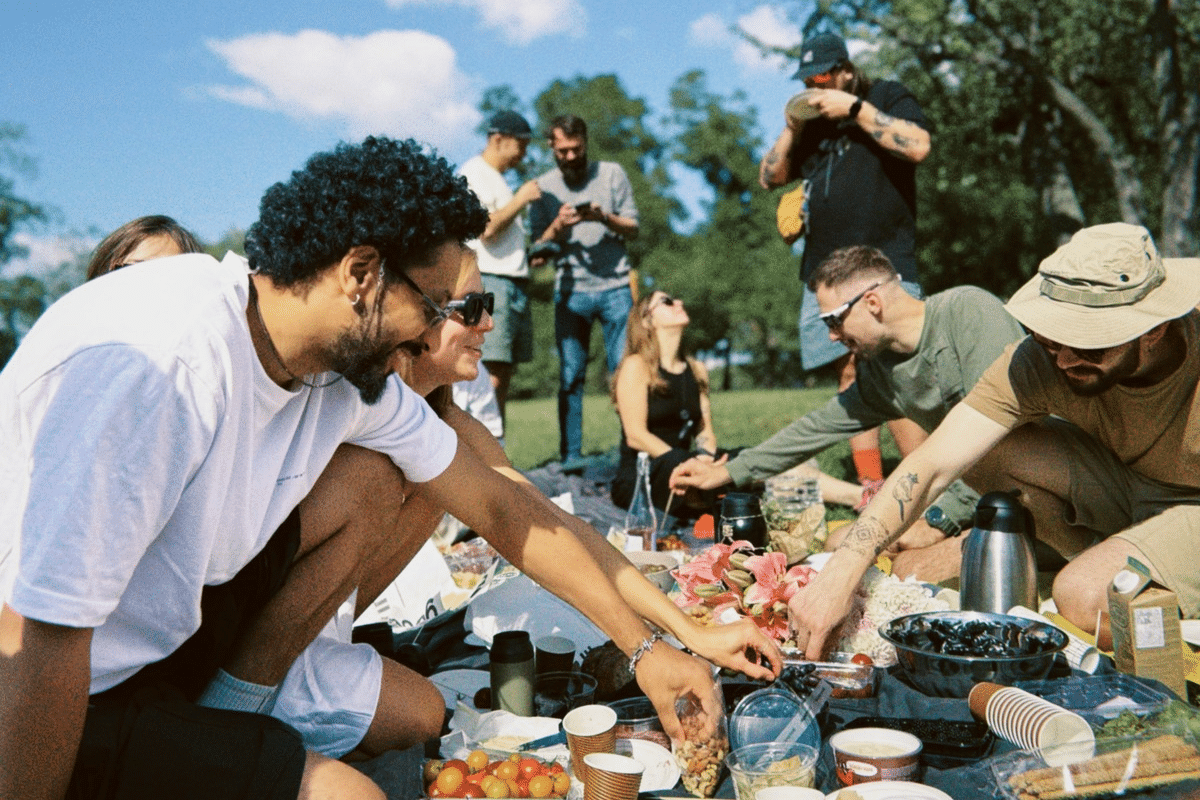
When life gets busy, catching up with a friend or getting to know a neighbour can feel like something we’ll get around to when everything else is done. But what if these everyday connections deserve more space in our lives?
Most of us know the familiar advice about looking after ourselves: eat well, get enough sleep and make time to move. We might be less likely to put spending time with other people in the same category. Relationships matter, of course, but they can become something we fit around the more pressing demands of work, family and everyday life.
In the first episode of our new podcast, Are We Good?, we explore why connection is so fundamental to being human, and what we might overlook when we treat it as an optional extra.
For social psychologist and writer Hugh Mackay, kindness and cooperation are central to understanding how we live together.
“Kindness is not just a nice thing to do,” he told us. “Kindness, it turns out, is a species survival skill.”
Listen now:
Why do we need other people?
We live in a world where dependence on others is viewed as something we gradually grow out of as we get older. We celebrate becoming independent, managing on our own and being able to take care of ourselves. But much of human life still depends on cooperation, even when we don’t notice it.
Evolutionary anthropologist Anna Machin points to the many things we learn from other people, the work involved in raising children and the practical demands of getting through each day. “Because we’re such a complicated species, particularly in terms of our brains, we actually rely on each other a lot to get through our daily lives,” she says.
That doesn’t mean living alongside other people is always straightforward. Cooperation involves coordinating our time, accommodating different needs and working through disagreements. Anyone who has shared a home or tried to organise a family gathering will recognise that tension.
Anna describes love, at its most basic biological level, as “a form of biological bribery”: a system that motivates and rewards us for starting and maintaining relationships that have been critical to our survival.
Needing people and sometimes finding them difficult aren’t contradictory experiences. They’re both part of being human.
Independence and connection can exist together
Living alone, travelling solo or making an important decision for ourselves can be deeply satisfying. Having meaningful connections doesn’t diminish those experiences or mean we need company all the time.
Elisabeth Shaw, CEO of Relationships Australia NSW, says what often matters is knowing there’s someone we can turn to. That could be in an emergency, after a breakup or when we need advice from someone who understands us.
“There’s something about the reliability of close others and knowing that they are in our corner and we’re in theirs, which is pretty critical for our survival and our wellbeing,” she explains.
The reassurance comes partly from feeling that we matter to someone. A friend makes time to listen when we’re struggling, or a family member celebrates our successes and stands by us when things become difficult.
“One of the things that’s most important is feeling quite deeply known,” Elisabeth says. Sometimes that means being able to speak in shorthand, knowing the other person understands our history without needing the whole story again.
These moments can look small from the outside but they can carry considerable meaning within a relationship.
Romantic love isn’t the only connection that counts
When we hear words like love and attachment, we often think of a romantic partner first. Cultural expectations can reinforce the idea that finding a partner is the most important relationship milestone, with other connections taking second place.
But the relationships that sustain us come in many forms. Friends, siblings, extended family and the people in our communities can all be important sources of affection, understanding and belonging.
Anna encourages us to question the assumption that romantic love is the defining measure of a fulfilled life. From an evolutionary perspective, our capacity for love may have developed to support attachment, cooperation, caregiving, and the survival of our communities, rather than to point us toward one predetermined romantic ideal. When it comes to the love we have in our lives, she says, “what that love is actually is entirely up to you”.
That can be a helpful shift, whether we’re single, partnered, separated or somewhere in between. It gives us room to recognise the connections we already value, as well as the ones we’d like to nurture.
It also takes some pressure off the idea that one person should meet every emotional need we have.
The people nearby can become part of our support network
The following section discusses domestic and family violence.
Some of our most meaningful relationships begin without much planning. For Daniel Mancuso and his brother Luke, a neighbour’s everyday kindness became an important source of comfort after a tragic event in their family. Their mother, Teresa, was killed by their father.
Their neighbour, Nina, began passing home-cooked meals over the fence. Daniel initially shared videos of these exchanges on his personal Instagram account. As people responded, he began to recognise that the moments represented something much bigger.
“It’s actually a story about our beautiful mum and how this lady has supported us during a traumatic time of our life,” he says.
Those exchanges eventually grew into YiaYia Next Door. But for Daniel, the relationship also meant having somewhere to go for a coffee, a conversation and a laugh on a difficult day. Knowing Nina and her husband were nearby brought a sense of reassurance.
His experience shows how care can develop through ordinary, repeated gestures. We don’t always need the perfect words to show someone they haven’t been forgotten.
What changes when we think of ourselves as part of a community?
Aunty Julie Wilson, our Aboriginal and Torres Strait Islander Practice Specialist, describes an understanding of connection grounded in responsibility to others.
Speaking about her culture and community, she explains how care for Elders, young people, family and community sits at the centre of life. Responsibility is shared, with people caring for others while also being cared for themselves.
“Because the responsibility you hold for others, they hold the responsibility for you,” she says.
Julie frames belonging as something we participate in. We have something to offer the people around us, and we can also allow ourselves to receive their care.
That participation doesn’t have to begin with a close friendship. Anna describes the wider connections in our lives as “loose ties”: people outside our closest circle who can still contribute to our sense of belonging. Familiar faces in the neighbourhood, people we chat to at school pick-up, or someone we regularly see at a local activity can all be part of that wider network.
Over time, familiarity can create opportunities for a deeper connection. As Daniel’s story shows, someone who happens to live nearby can become an important person in our life.
Relationships are not meant to be perfect
Knowing connection matters doesn’t automatically make it easy to prioritise. A survey commissioned by Relationships Australia NSW asked Australians what made their relationships harder to maintain. Tiredness, financial pressure, busyness, and not being in the right headspace were among the barriers people described.
These are real pressures. Making room for relationships needs to be possible within the lives we actually have.
It might mean calling a friend rather than waiting until we have time for a long catch-up, asking a neighbour how they’re going or remembering to check in after something we know mattered to someone.
It also means accepting that relationships won’t always be tidy or predictable. Anna cautions against turning them into another area of life we’re expected to perfect. “You can make efforts in the relationship, you can try and do good things in the relationship,” she says, but the idea of achieving a perfectly optimised relationship is simply unrealistic.
We can give our relationships attention without measuring every interaction or expecting ourselves to get everything right. Sometimes, making a little more room for each other is a worthwhile place to start.
Keep exploring the connections that matter
These are some of the ideas we explore in “Connection is Protection”, the first episode of Are We Good?, our podcast about the relationships that shape our lives.
Episode 1 of Are We Good? is out now. Find us wherever you get your podcasts.

 English (UK)
 العربية
 简体中文
 香港中文
 Ελληνικά
 Italiano
 한국어
 ਪੰਜਾਬੀ
 Српски језик
 ไทย
 Tiếng Việt
 Facebook
 Twitter
 Linkedin
 Email