





Have you ever spent hours thinking about how to raise something with someone you love, only to decide it’s easier not to mention it? Or walked away from an argument wishing you’d said what you actually meant, rather than becoming defensive, shutting down or saying something you regretted?
For something we do throughout our entire lives, relationships come with surprisingly little preparation. We learn how to read and write, manage money, and drive a car. But many of the skills we rely on in our closest relationships – saying what we need, listening when we disagree, setting boundaries, apologising and finding our way back after conflict – are things we’re often expected to work out as we go.
A new survey commissioned by Relationships Australia NSW suggests many of us feel that gap. Only one in three Australians say they were taught how to handle difficult conversations in relationships while growing up, while 40% say they weren’t. There is a generational difference too, with 53% of Gen X saying they weren’t taught these skills, compared with 32% of Gen Z.
So, if we weren’t explicitly taught how to navigate the more difficult parts of relationships, where did we learn it?
We were learning about relationships all along
Most of us probably did receive some kind of relationship education growing up, even if it never looked like a lesson. Long before our first romantic relationship, we were watching how the people around us related to one another: what happened when adults disagreed, whether feelings were talked about or hidden, how affection was expressed, and what happened after somebody got hurt.
Dee Salmin, host of triple j’s The Hook Up, describes this as learning a relationship “blueprint”. When we spoke to her for our new podcast, Are We Good?, she reflected that “so much of what we learn about relationships” comes from our parents, caregivers and the other people around us.
If the adults in our lives could disagree, repair hurt and reconnect afterwards, we may have learnt that conflict was manageable. If difficult feelings led to shouting, silence or withdrawal, we may have absorbed very different lessons.
These early experiences can show up in ways we don’t immediately recognise as adults. Psychological researcher Dr Raquel Peel told us that people can find themselves noticing, “Every relationship that I get into, I see myself doing the same things.” Her research into relationship sabotage grew from an interest in exactly these recurring patterns.
Understanding where a pattern comes from isn’t about blaming our parents or assuming our childhood determines the relationships we’ll have forever. The adults who raised us were working from their own experiences and relationship blueprints too. But becoming curious about what we learnt can help us recognise which lessons are helpful now, and which ones we might want to approach differently.
What are we taught at school?
For many adults, formal education probably didn’t fill in these gaps either. Respectful relationships education has historically varied across Australia, with a national review led by Monash University finding significant differences in how it was understood and delivered between schools, sectors, states and territories.
Fortunately, this is beginning to change. The Australian Curriculum now includes more explicit teaching about positive and respectful relationships and consent from Foundation to Year 10, and the Australian Government released Australia’s first National Respectful Relationships Education Framework in March 2026. In NSW, students from Kindergarten to Year 10 receive age-appropriate education about respectful and safe relationships through the mandatory PDHPE curriculum.
There are good reasons for taking these skills more seriously. Respectful relationships and consent education isn’t simply about helping young people communicate better. Australia’s National Plan to End Violence against Women and Children 2022-2032 identifies this education as an important part of preventing gender-based violence by addressing attitudes towards respect, equality, consent and relationships before harmful patterns become established.
Schools can’t carry that responsibility alone, though. Children are still learning from what happens everywhere else in their lives.
Our ideas about relationships come from culture too
Family and school are only part of the picture. Friends, books, films, television, gender expectations and, increasingly, social media can all shape what we think relationships are supposed to look like.
Dee remembers growing up with romantic stories that suggested finding love was the ultimate happy ending. Later, as the only single friend in her group, she began to feel there was something wrong with her and that it would take being in a relationship to somehow prove she was lovable. “It took me a long time to kind of unlearn that,” she told us.
That idea of ‘unlearning’ is an important one. Sometimes what we’re carrying into adulthood isn’t an absence of relationship education at all. We’ve learnt plenty from the people and culture around us; the challenge is that some of those lessons may not be particularly helpful.
For boys and young men, for example, messages about masculinity can influence whether vulnerability and emotional expression feel acceptable. Ben Vasiliou, CEO of preventative mental health charity The Man Cave, told us that in a survey of a couple of thousand boys, only 31% initially said they felt they could talk to their mates about problems in their lives. After participating in a Man Cave workshop designed to support emotional literacy and expression, 75% said they felt more comfortable doing so.
What Ben sees in those workshops is not a lack of interest in connection. “They’re ready to share, they want to talk, they want to connect.” The feelings and friendships were already there; what some of the boys needed was an opportunity, and an avenue, to start the conversation.
Knowing the language isn’t the same as having the skill
In some ways, we’re now surrounded by more information about relationships than ever before. Dee has watched this shift during her years hosting The Hook Up. She says younger people are more open to therapy, know more of the language to express how they’re feeling, and are actively interested in understanding themselves and their relationships.
Having language for our experiences can be enormously useful. But knowing the language and being able to put it into practice are different things, particularly when we’re hurt, angry, embarrassed or frightened.
Most of us know, for example, that listening is important during a disagreement. But actually listening when someone we love has just said something we think is unfair is much harder.
Social researcher Hugh Mackay describes listening as something that “requires great patience”. It also takes courage, he says, because really listening to someone – particularly when a relationship is going through a difficult period – means being open to hearing something we may not want to hear.
“If I listen to you talking about your view of me and why our relationship might have hit turbulence, I’m not going to enjoy that because it might ring true,” Hugh says. We might realise that we’ve been impatient, or that we haven’t listened as attentively or empathically as we could have. “And now I’m going to have to admit that, and change.”
Understanding that we should listen is relatively straightforward. Learning to stay present when what we’re hearing is difficult is the skill we need to keep practising.
Why are difficult conversations so tough?
There’s often something meaningful at stake when we raise a sensitive issue with someone we care about. We might worry they’ll become angry, reject us, misunderstand what we’re saying or see us differently. Sometimes saying nothing feels less risky than finding out what might happen if we speak.
Our earlier experiences can shape these reactions too. If disagreeing was explosive or frightening in the family we grew up in, conflict might make us particularly anxious. If problems were dealt with through silence, talking openly about hurt can feel unusually exposing.
The aim isn’t necessarily to reach a point where difficult conversations stop feeling difficult. Some conversations will always involve discomfort, particularly when the relationship matters deeply to us. What we can learn is how to tolerate enough of that discomfort to listen, communicate what we mean and respond with care, rather than immediately attacking, withdrawing or avoiding the conversation altogether.
And because none of us will do that perfectly every time, repair matters too. Being able to return to a conversation, acknowledge our part in what happened, apologise where we need to and try again can be just as important as knowing how to start the conversation.
We can learn what we weren’t taught
Our research offers an interesting glimpse of why that might matter. Among Australians who said their relationships had positively affected their mental health, 39% said they had been taught how to handle difficult conversations growing up, compared with 22% of those who said their relationships had negatively affected their mental health.
Those findings don’t tell us that being taught these skills caused people to have healthier relationships, because relationships and mental health are shaped by many different factors. They do, however, reinforce a broader point: the ways we communicate, manage disagreement and repair hurt are skills worth taking seriously.
Learning them doesn’t mean becoming an expert in therapy language or never losing your temper again. It might mean noticing that you tend to shut down when a conversation becomes uncomfortable, learning to ask for what you need rather than hoping somebody will guess, or catching yourself becoming defensive and trying to listen before responding. Sometimes it might be as simple – and as difficult – as coming back after an argument and saying, “I don’t think I handled that very well. Can we try again?”
Some skills develop naturally through relationships with people who model a different way of communicating, while counselling and relationship education can give us space to understand recurring patterns and practise new approaches. What matters is recognising that the ways we relate to other people aren’t simply fixed parts of our personality.
As Dee told us, learning about relationships is “a never-ending part of our lives”. Perhaps that’s the more hopeful answer to the question of why nobody taught us how to have difficult conversations: increasingly, we’re recognising that these skills can be taught, and that learning doesn’t have to end when we leave school.
Keep the conversation going with Are We Good?
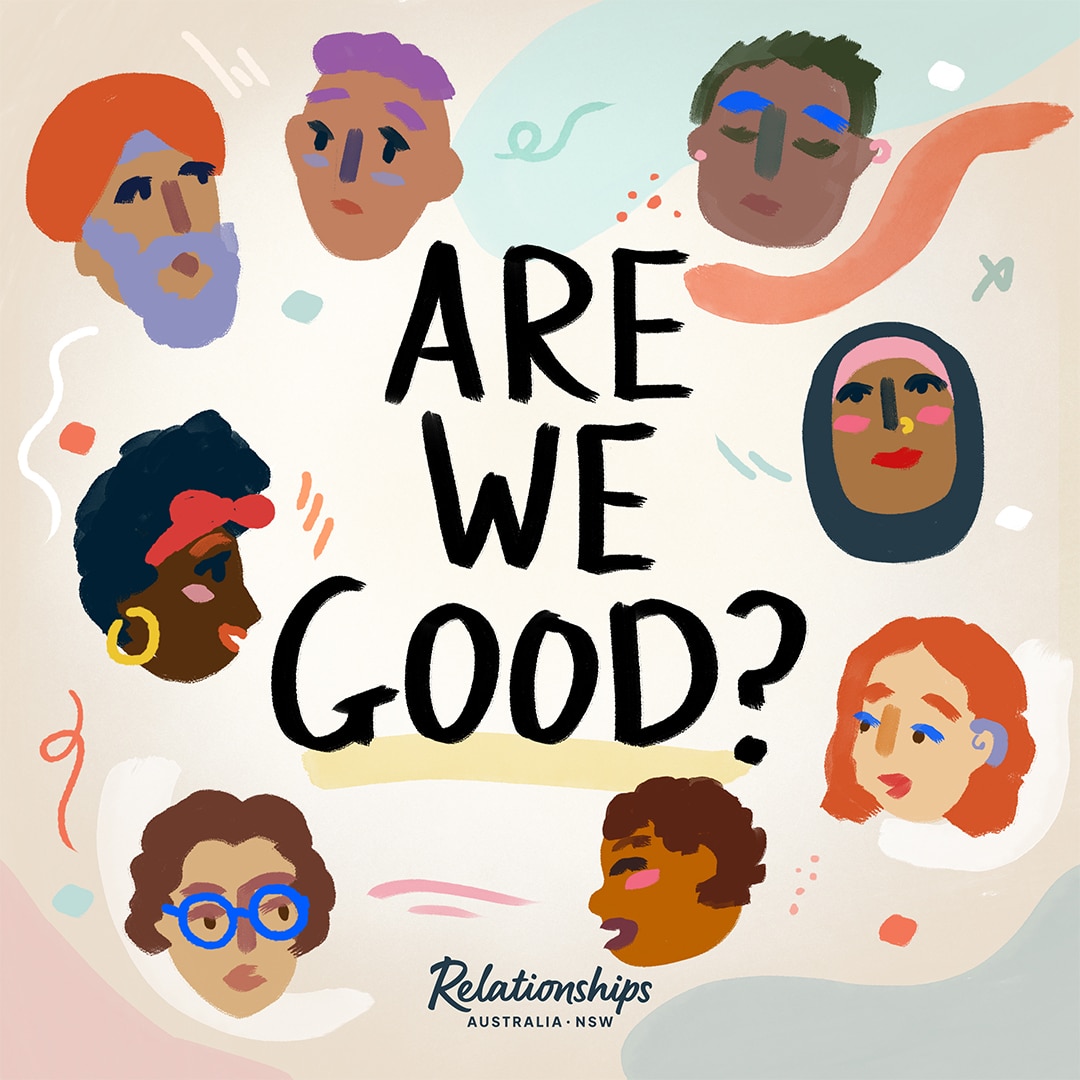
These are some of the questions we explore in Are We Good?, a new podcast from Relationships Australia NSW about the relationships that shape our lives and what it actually takes to build and sustain good ones.
Across the series, we speak with researchers, practitioners and familiar voices including Dee Salmin, Ben Vasiliou, Dr Raquel Peel and Hugh Mackay about everything from loneliness and friendship to conflict, communication and the relationship lessons many of us are still learning as adults.


 English (UK)
  العربية
  简体中文
简体中文  香港中文
香港中文  Ελληνικά
  Italiano
  한국어
한국어  ਪੰਜਾਬੀ
  Српски језик
  ไทย
ไทย  Tiếng Việt
  Facebook
 Twitter
 Linkedin
 Email
Email